Bushy Park images of Bushy Park
History and Architecture

Before a Royal Park......
The flat site of Bushy Park has been settled for at least 4,000 years. A Bronze Age barrow & burial mound was excavated near Sandy Lane and the contents are now housed in the British Museum. There are clear remains of medieval settlements, with the finest example found South of Waterhouse Woodland Gardens, where there are traces of the largest and most complex field system in Middlesex.

The Longford River
King Charles I had the idea of creating an artificial waterway in the Park because Hampton Court Palace was always short of water. There was nowhere locally with a sufficient fall of water and so the Longford River was built exceeding 19 kilometres in length. It was designed by Nicholas Lane in 1638-39. It was built by hand, took 9 months to complete and cost £4000!
Longford River © Royal Parks Agency

Chestnut Avenue
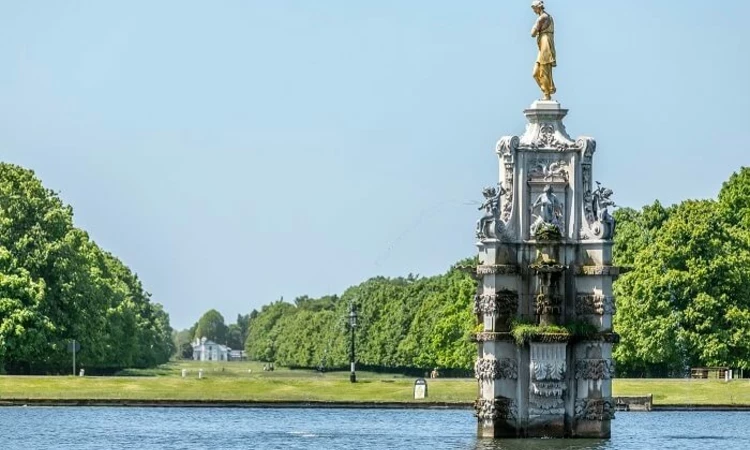
This mile long avenue was conceived by Sir Christopher Wren as a formal approach to Hampton Court Palace in the reign of William III & Mary II. Flanked on both sides by a single row of horse chestnuts and four rows of limes, it marks the Park's zenith in terms of royal ambitions and sophistication. The view from Teddington Gate provides the most striking view of the Avenue, with the Arethusa 'Diana' Fountain and the Banqueting Hall as the backdrop.

The House of Windsor
During the First World War (WWI), areas of land in the Park were turned over to the plough to 'Dig for Victory'. King George V gave his permission to use Upper Lodge as a home for Canadian Convalescents. Queen Mary visited the troops and made sure entertainment was provided with the help of local people. This Canadian tie with the Park is commemorated by the Totem Pole and the Canadian Glade in the Waterhouse Woodland Gardens.

During the Second World War (WWII) large areas of the Parks were again turned over for the production of food.

From 1942, Bushy Park became the site of a large U.S. base called Camp Griffiss, headquarters to a number of the Allied departments. General Dwight Eisenhower was averse to working in the centre of London during the Second World War. He decided instead to make Bushy Park the Supreme Headquarters Allied Expeditionary Force (SHAEF) centre for planning Operation Overlord, the 1944 D-Day.

The Bushy Park History Room
Operational since 1995 and manned by volunteers, the History Room is situated within White Lodge at the Stockyard. Visitors are welcome by prior appointment with the Park Office.

Records and information are available on Camp Griffiss, Upper Lodge, The Annular Tank, The Berlin Airlift and many other areas of the Park's history.

The Royal Parks

History and Architecture

Bushy Park images of Bushy Park
History and Architecture

Before a Royal Park......
The flat site of Bushy Park has been settled for at least 4,000 years. A Bronze Age barrow & burial mound was excavated near Sandy Lane and the contents are now housed in the British Museum. There are clear remains of medieval settlements, with the finest example found South of Waterhouse Woodland Gardens, where there are traces of the largest and most complex field system in Middlesex.

The Longford River
King Charles I had the idea of creating an artificial waterway in the Park because Hampton Court Palace was always short of water. There was nowhere locally with a sufficient fall of water and so the Longford River was built exceeding 19 kilometres in length. It was designed by Nicholas Lane in 1638-39. It was built by hand, took 9 months to complete and cost £4000!
Longford River © Royal Parks Agency

Chestnut Avenue
This mile long avenue was conceived by Sir Christopher Wren as a formal approach to Hampton Court Palace in the reign of William III & Mary II. Flanked on both sides by a single row of horse chestnuts and four rows of limes, it marks the Park's zenith in terms of royal ambitions and sophistication. The view from Teddington Gate provides the most striking view of the Avenue, with the Arethusa 'Diana' Fountain and the Banqueting Hall as the backdrop.

The House of Windsor
During the First World War (WWI), areas of land in the Park were turned over to the plough to 'Dig for Victory'. King George V gave his permission to use Upper Lodge as a home for Canadian Convalescents. Queen Mary visited the troops and made sure entertainment was provided with the help of local people. This Canadian tie with the Park is commemorated by the Totem Pole and the Canadian Glade in the Waterhouse Woodland Gardens.

During the Second World War (WWII) large areas of the Parks were again turned over for the production of food.

From 1942, Bushy Park became the site of a large U.S. base called Camp Griffiss, headquarters to a number of the Allied departments. General Dwight Eisenhower was averse to working in the centre of London during the Second World War. He decided instead to make Bushy Park the Supreme Headquarters Allied Expeditionary Force (SHAEF) centre for planning Operation Overlord, the 1944 D-Day.

The Bushy Park History Room
Operational since 1995 and manned by volunteers, the History Room is situated within White Lodge at the Stockyard. Visitors are welcome by prior appointment with the Park Office.

Records and information are available on Camp Griffiss, Upper Lodge, The Annular Tank, The Berlin Airlift and many other areas of the Park's history.

The Royal Parks
Landing Image
History and Architecture

This is some blurb text. This should be changed in the metadata screen for this asset.


Buy Plants Online

Headspace

Royal Parks Shop

Royal Parks Shop

In History and Architecture

No results

Royal Parks Store

Visit the Royal Parks Shop

Lorem Ipsum

Lorem ipsum dolor sit amet pulvinar consectetur elit adisciplin donec avec elit magna pul vinar estbul ipsum elit sit donec ipsum.

Buy now...

Things to see

  • Thing to see 1

    Thing to see 1

    Enter a brief description of the page. This should be a summary of the contents and theme of the page.

    More things to see...
  • Thing to see 2

    Thing to see 2

    Enter a brief description of the page. This should be a summary of the contents and theme of the page.

    More things to see...
  • Thing to see 3

    Thing to see 3

    Enter a brief description of the page. This should be a summary of the contents and theme of the page.

    More things to see...
  • Thing to see 4

    Thing to see 4

    Enter a brief description of the page. This should be a summary of the contents and theme of the page.

    More things to see...

Things to do

  • Thing to do 1

    Thing to do 1

    Enter a brief description of the page. This should be a summary of the contents and theme of the page.

    More things to do...
  • Thing to do 2

    Thing to do 2

    Enter a brief description of the page. This should be a summary of the contents and theme of the page.

    More things to do...
  • Thing to do 3

    Thing to do 3

    Enter a brief description of the page. This should be a summary of the contents and theme of the page.

    More things to do...
  • Thing to do 4

    Thing to do 4

    Enter a brief description of the page. This should be a summary of the contents and theme of the page.

    More things to do...

Connect with us

Facebook Icon Flickr Icon YouTube Icon Twitter Icon
Bushy Park images of Bushy Park
History and Architecture

Before a Royal Park......
The flat site of Bushy Park has been settled for at least 4,000 years. A Bronze Age barrow & burial mound was excavated near Sandy Lane and the contents are now housed in the British Museum. There are clear remains of medieval settlements, with the finest example found South of Waterhouse Woodland Gardens, where there are traces of the largest and most complex field system in Middlesex.

The Longford River
King Charles I had the idea of creating an artificial waterway in the Park because Hampton Court Palace was always short of water. There was nowhere locally with a sufficient fall of water and so the Longford River was built exceeding 19 kilometres in length. It was designed by Nicholas Lane in 1638-39. It was built by hand, took 9 months to complete and cost £4000!
Longford River © Royal Parks Agency

Chestnut Avenue
This mile long avenue was conceived by Sir Christopher Wren as a formal approach to Hampton Court Palace in the reign of William III & Mary II. Flanked on both sides by a single row of horse chestnuts and four rows of limes, it marks the Park's zenith in terms of royal ambitions and sophistication. The view from Teddington Gate provides the most striking view of the Avenue, with the Arethusa 'Diana' Fountain and the Banqueting Hall as the backdrop.

The House of Windsor
During the First World War (WWI), areas of land in the Park were turned over to the plough to 'Dig for Victory'. King George V gave his permission to use Upper Lodge as a home for Canadian Convalescents. Queen Mary visited the troops and made sure entertainment was provided with the help of local people. This Canadian tie with the Park is commemorated by the Totem Pole and the Canadian Glade in the Waterhouse Woodland Gardens.

During the Second World War (WWII) large areas of the Parks were again turned over for the production of food.

From 1942, Bushy Park became the site of a large U.S. base called Camp Griffiss, headquarters to a number of the Allied departments. General Dwight Eisenhower was averse to working in the centre of London during the Second World War. He decided instead to make Bushy Park the Supreme Headquarters Allied Expeditionary Force (SHAEF) centre for planning Operation Overlord, the 1944 D-Day.

The Bushy Park History Room
Operational since 1995 and manned by volunteers, the History Room is situated within White Lodge at the Stockyard. Visitors are welcome by prior appointment with the Park Office.

Records and information are available on Camp Griffiss, Upper Lodge, The Annular Tank, The Berlin Airlift and many other areas of the Park's history.

The Royal Parks