Bushy Park is like a patchwork quilt of English history. It has remains of medieval farmland, a Tudor deer park, 17th century water gardens and wartime camps.
Bushy became a royal park in 1529 when Cardinal Wolsey gave it to King Henry Vlll as part of a gift that also included Hampton Court. Until then, the park had been agricultural land. On the edge of the Woodland Gardens, you can still make out the line of a medieval
track and ditch. Rows of tangled hawthorns are the remnants of ancient field hedges. There are traces of ridge and furrow ploughing - and the area between Lime Avenue and the Woodland Gardens has the most extensive evidence of a medieval field system in Middlesex.
In the Middle Ages, the park reared rabbits for food in artificial warrens. You can still see signs of the warrens. The best examples are at Warren Plantation and north of the junction between Lime Avenue and Chestnut Avenue.
When the land was given to King Henry Vlll, he immediately created a deer chase. He built a brick wall around the park - and a section of this remains along the north side of Hampton Court Road.
Deer continued to be hunted at Bushy throughout the 17 th century - but the character of the park changed. In 1610, King Charles I created the Longford River . This was an ornamental canal, 19km (12 miles) long, which brought water from the River Colne in Hertfordshire to water features in the park. The canal was dug by hand but it now appears to be a natural part of the landscape and supports many plants and animals.
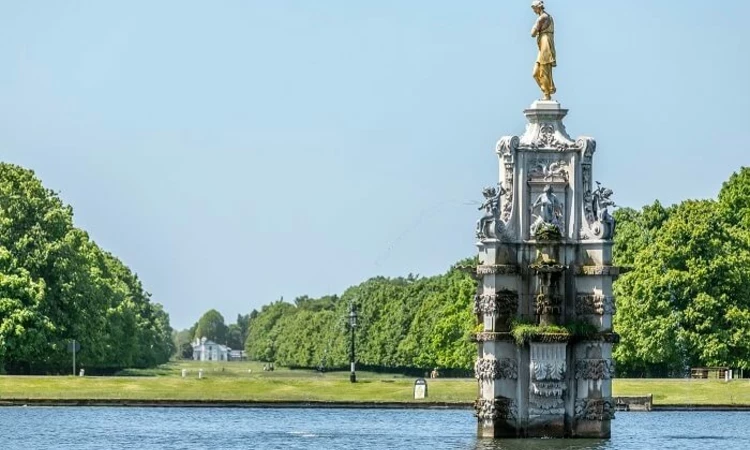
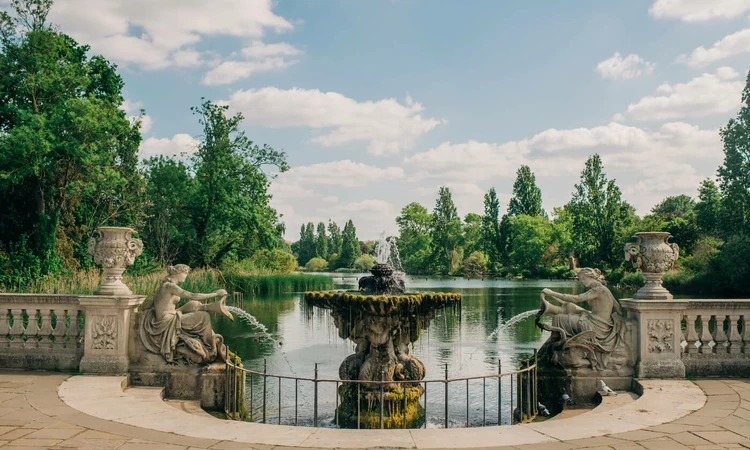
King Charles l also commissioned a statue and fountain for his Queen, Henrietta Maria. It first stood at Somerset House but was moved by Oliver Cromwell to the Privy Garden at Hampton Court. In 1713 the statue and fountain moved again. The architect, Sir Christopher Wren, had redesigned the Chestnut Avenue at Bushy to make a long, formal route through the middle of the park. At one end, he added a large round pond and put the statue and fountain in the middle of it. The feature is known as the Diana fountain after the Roman goddess of hunting. But the statue actually represents Diana's nymph, Arethusa.
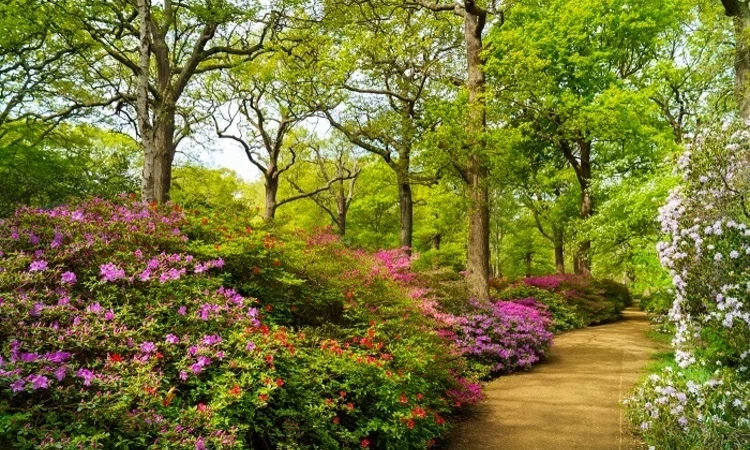
Houses were added to the park in the 17th and 18th centuries. These were used as hunting lodges and homes for the ranger. One of them, Bushy House, now belongs to the National Physical Laboratory. New gardens were also planted at this time. The most important are the Woodland Gardens in the south-east corner. They were created in the 20th century and include the Waterhouse and Pheasantry Plantations. This area is now being restored as part of a £7.2million project, part funded by the Heritage Lottery Fund.
During World War 1, Canadian troops were stationed in the park and Upper Lodge became the King's Canadian Hospital. A totem pole was installed in 1992 in the Woodland Garden to remember this connection with Canada.
In World War 2, part of the park became Camp Griffiss, the base for the US 8th Army Air Force, US Strategic Air Forces and later the Supreme Headquarters Allied Expeditionary Forces. This was where General Eisenhower planned Operation Overlord, the code name for the allied invasion of north-west Europe that began with the D-D landings. Most of the camp's huts were removed by 1963 but you can still see remains of drain covers and stones poking through the grass. There are formal memorials to the USAAF and SHAEF in the north-east corner of the park.
Bushy Park is like a patchwork quilt of English history. It has remains of medieval farmland, a Tudor deer park, 17th century water gardens and wartime camps.
Bushy became a royal park in 1529 when Cardinal Wolsey gave it to King Henry Vlll as part of a gift that also included Hampton Court. Until then, the park had been agricultural land. On the edge of the Woodland Gardens, you can still make out the line of a medieval
track and ditch. Rows of tangled hawthorns are the remnants of ancient field hedges. There are traces of ridge and furrow ploughing - and the area between Lime Avenue and the Woodland Gardens has the most extensive evidence of a medieval field system in Middlesex.
In the Middle Ages, the park reared rabbits for food in artificial warrens. You can still see signs of the warrens. The best examples are at Warren Plantation and north of the junction between Lime Avenue and Chestnut Avenue.
When the land was given to King Henry Vlll, he immediately created a deer chase. He built a brick wall around the park - and a section of this remains along the north side of Hampton Court Road.
Deer continued to be hunted at Bushy throughout the 17 th century - but the character of the park changed. In 1610, King Charles I created the Longford River . This was an ornamental canal, 19km (12 miles) long, which brought water from the River Colne in Hertfordshire to water features in the park. The canal was dug by hand but it now appears to be a natural part of the landscape and supports many plants and animals.
King Charles l also commissioned a statue and fountain for his Queen, Henrietta Maria. It first stood at Somerset House but was moved by Oliver Cromwell to the Privy Garden at Hampton Court. In 1713 the statue and fountain moved again. The architect, Sir Christopher Wren, had redesigned the Chestnut Avenue at Bushy to make a long, formal route through the middle of the park. At one end, he added a large round pond and put the statue and fountain in the middle of it. The feature is known as the Diana fountain after the Roman goddess of hunting. But the statue actually represents Diana's nymph, Arethusa.
Houses were added to the park in the 17th and 18th centuries. These were used as hunting lodges and homes for the ranger. One of them, Bushy House, now belongs to the National Physical Laboratory. New gardens were also planted at this time. The most important are the Woodland Gardens in the south-east corner. They were created in the 20th century and include the Waterhouse and Pheasantry Plantations. This area is now being restored as part of a £7.2million project, part funded by the Heritage Lottery Fund.
During World War 1, Canadian troops were stationed in the park and Upper Lodge became the King's Canadian Hospital. A totem pole was installed in 1992 in the Woodland Garden to remember this connection with Canada.
In World War 2, part of the park became Camp Griffiss, the base for the US 8th Army Air Force, US Strategic Air Forces and later the Supreme Headquarters Allied Expeditionary Forces. This was where General Eisenhower planned Operation Overlord, the code name for the allied invasion of north-west Europe that began with the D-D landings. Most of the camp's huts were removed by 1963 but you can still see remains of drain covers and stones poking through the grass. There are formal memorials to the USAAF and SHAEF in the north-east corner of the park.
This is some blurb text. This should be changed in the metadata screen for this asset.
Lorem ipsum dolor sit amet pulvinar consectetur elit adisciplin donec avec elit magna pul vinar estbul ipsum elit sit donec ipsum.
Buy now...
Barclaycard presents British Summer Time Hyde Park, a ground breaking new concert series and outdoor experience from 5 July - 14 July 2013.
More things to do...
A permanent memorial to honour the victims of the 7 July 2005 London Bombings was unveiled in Hyde Park by Their Royal Highnesses, The Prince of Wales and The Duchess of Cornwall.
More things to do...
This unique Memorial to Diana, Princess of Wales was opened by Her Majesty The Queen on 6th July 2004 and was built with the best materials, talent and technology.
More things to do...
Royal Gun Salutes mark special royal occasions. On these days salutes are fired from locations in London including Hyde Park and Green Park.
More things to do...
Daily public swimming in The Serpentine from June - September. Serpentine Swimming Club swims every day, including the famous race on Christmas day.
More things to do...
Rowing and pedal boats are available to hire on the Serpentine in Hyde Park. You can also take a ride on the UK's first Solarshuttle, powered only by the sun.
More things to do...
The Diana Princess of Wales Memorial Walk is a seven-mile-long walk, charted by 90 plaques set in the ground, that takes you within sight of famous buildings and locations associated with the Princess during her life.
More things to do...Bushy Park is like a patchwork quilt of English history. It has remains of medieval farmland, a Tudor deer park, 17th century water gardens and wartime camps.
Bushy became a royal park in 1529 when Cardinal Wolsey gave it to King Henry Vlll as part of a gift that also included Hampton Court. Until then, the park had been agricultural land. On the edge of the Woodland Gardens, you can still make out the line of a medieval
track and ditch. Rows of tangled hawthorns are the remnants of ancient field hedges. There are traces of ridge and furrow ploughing - and the area between Lime Avenue and the Woodland Gardens has the most extensive evidence of a medieval field system in Middlesex.
In the Middle Ages, the park reared rabbits for food in artificial warrens. You can still see signs of the warrens. The best examples are at Warren Plantation and north of the junction between Lime Avenue and Chestnut Avenue.
When the land was given to King Henry Vlll, he immediately created a deer chase. He built a brick wall around the park - and a section of this remains along the north side of Hampton Court Road.
Deer continued to be hunted at Bushy throughout the 17 th century - but the character of the park changed. In 1610, King Charles I created the Longford River . This was an ornamental canal, 19km (12 miles) long, which brought water from the River Colne in Hertfordshire to water features in the park. The canal was dug by hand but it now appears to be a natural part of the landscape and supports many plants and animals.
King Charles l also commissioned a statue and fountain for his Queen, Henrietta Maria. It first stood at Somerset House but was moved by Oliver Cromwell to the Privy Garden at Hampton Court. In 1713 the statue and fountain moved again. The architect, Sir Christopher Wren, had redesigned the Chestnut Avenue at Bushy to make a long, formal route through the middle of the park. At one end, he added a large round pond and put the statue and fountain in the middle of it. The feature is known as the Diana fountain after the Roman goddess of hunting. But the statue actually represents Diana's nymph, Arethusa.
Houses were added to the park in the 17th and 18th centuries. These were used as hunting lodges and homes for the ranger. One of them, Bushy House, now belongs to the National Physical Laboratory. New gardens were also planted at this time. The most important are the Woodland Gardens in the south-east corner. They were created in the 20th century and include the Waterhouse and Pheasantry Plantations. This area is now being restored as part of a £7.2million project, part funded by the Heritage Lottery Fund.
During World War 1, Canadian troops were stationed in the park and Upper Lodge became the King's Canadian Hospital. A totem pole was installed in 1992 in the Woodland Garden to remember this connection with Canada.
In World War 2, part of the park became Camp Griffiss, the base for the US 8th Army Air Force, US Strategic Air Forces and later the Supreme Headquarters Allied Expeditionary Forces. This was where General Eisenhower planned Operation Overlord, the code name for the allied invasion of north-west Europe that began with the D-D landings. Most of the camp's huts were removed by 1963 but you can still see remains of drain covers and stones poking through the grass. There are formal memorials to the USAAF and SHAEF in the north-east corner of the park.