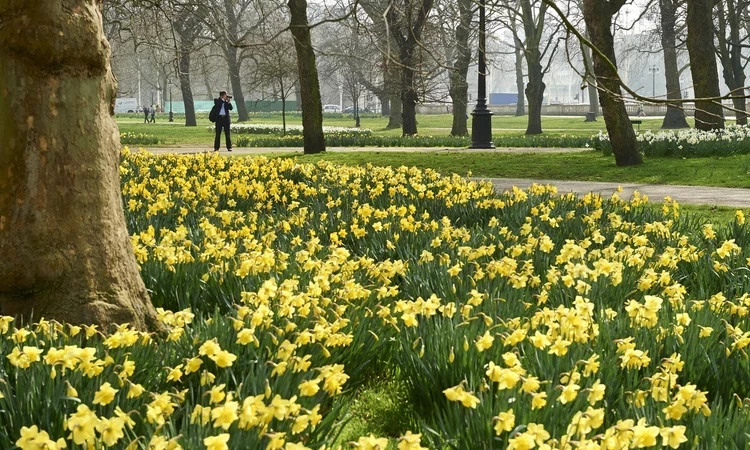
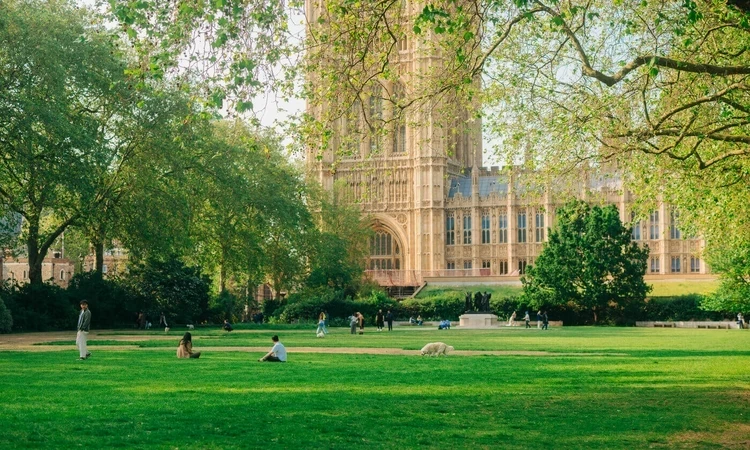
The Green Park covers 40 acres and is an important link between St James's Park and Hyde Park in forming a chain of open spaces that contribute so much to life in the capital.
The park was first recorded in 1554 when Sir Thomas Wyatt led a rebellion in protest against the marriage of Mary I to Philip II of Spain. The area was meadowland used for hunting and the occasional duel.
The Green Park is now devoid of buildings and has virtually no artefacts, but it was not always so. The park once contained lodges, a library, an ice house and two vast 'temples' called the Temple of Peace and the Temple of Concord. During festivities in the park the two temples were destroyed. In 1749 the Hugh Temple of Peace, erected to mark the end of the War of Austrian Succession, exploded during a firework display and in 1814 the Temple of Concord, erected to mark 100 years of the Hanoverian Dynasty, was also destroyed in a similar way during the Prince Regent's gala.
The park was enclosed by Charles II in 1668, stocked with deer and provided with a ranger's house. It was known as Upper St James's Park but by 1746 it was called The Green Park. Various improvements at the beginning of the 18th century made it more of a pleasure garden. The Tyburn Pool was built, and in the 1720s a reservoir was made to supply water to St James's Palace and Buckingham House. This reservoir was called the Queen's Basin, and with the adjacent Queen's Walk, planted in 1730, soon became a fashionable venue. The park was opened to the general public in 1826. Unfortunately, The Ranger's Lodge, the Queen's Library, the Queen's Basin and the Tyburn Pool had all been demolished by 1855.
The Green Park covers 40 acres and is an important link between St James's Park and Hyde Park in forming a chain of open spaces that contribute so much to life in the capital.
The park was first recorded in 1554 when Sir Thomas Wyatt led a rebellion in protest against the marriage of Mary I to Philip II of Spain. The area was meadowland used for hunting and the occasional duel.
The Green Park is now devoid of buildings and has virtually no artefacts, but it was not always so. The park once contained lodges, a library, an ice house and two vast 'temples' called the Temple of Peace and the Temple of Concord. During festivities in the park the two temples were destroyed. In 1749 the Hugh Temple of Peace, erected to mark the end of the War of Austrian Succession, exploded during a firework display and in 1814 the Temple of Concord, erected to mark 100 years of the Hanoverian Dynasty, was also destroyed in a similar way during the Prince Regent's gala.
The park was enclosed by Charles II in 1668, stocked with deer and provided with a ranger's house. It was known as Upper St James's Park but by 1746 it was called The Green Park. Various improvements at the beginning of the 18th century made it more of a pleasure garden. The Tyburn Pool was built, and in the 1720s a reservoir was made to supply water to St James's Palace and Buckingham House. This reservoir was called the Queen's Basin, and with the adjacent Queen's Walk, planted in 1730, soon became a fashionable venue. The park was opened to the general public in 1826. Unfortunately, The Ranger's Lodge, the Queen's Library, the Queen's Basin and the Tyburn Pool had all been demolished by 1855.
This is some blurb text. This should be changed in the metadata screen for this asset.
Lorem ipsum dolor sit amet pulvinar consectetur elit adisciplin donec avec elit magna pul vinar estbul ipsum elit sit donec ipsum.
Buy now...
Barclaycard presents British Summer Time Hyde Park, a ground breaking new concert series and outdoor experience from 5 July - 14 July 2013.
More things to do...
A permanent memorial to honour the victims of the 7 July 2005 London Bombings was unveiled in Hyde Park by Their Royal Highnesses, The Prince of Wales and The Duchess of Cornwall.
More things to do...
This unique Memorial to Diana, Princess of Wales was opened by Her Majesty The Queen on 6th July 2004 and was built with the best materials, talent and technology.
More things to do...
Royal Gun Salutes mark special royal occasions. On these days salutes are fired from locations in London including Hyde Park and Green Park.
More things to do...
Daily public swimming in The Serpentine from June - September. Serpentine Swimming Club swims every day, including the famous race on Christmas day.
More things to do...
Rowing and pedal boats are available to hire on the Serpentine in Hyde Park. You can also take a ride on the UK's first Solarshuttle, powered only by the sun.
More things to do...
The Diana Princess of Wales Memorial Walk is a seven-mile-long walk, charted by 90 plaques set in the ground, that takes you within sight of famous buildings and locations associated with the Princess during her life.
More things to do...The Green Park covers 40 acres and is an important link between St James's Park and Hyde Park in forming a chain of open spaces that contribute so much to life in the capital.
The park was first recorded in 1554 when Sir Thomas Wyatt led a rebellion in protest against the marriage of Mary I to Philip II of Spain. The area was meadowland used for hunting and the occasional duel.
The Green Park is now devoid of buildings and has virtually no artefacts, but it was not always so. The park once contained lodges, a library, an ice house and two vast 'temples' called the Temple of Peace and the Temple of Concord. During festivities in the park the two temples were destroyed. In 1749 the Hugh Temple of Peace, erected to mark the end of the War of Austrian Succession, exploded during a firework display and in 1814 the Temple of Concord, erected to mark 100 years of the Hanoverian Dynasty, was also destroyed in a similar way during the Prince Regent's gala.
The park was enclosed by Charles II in 1668, stocked with deer and provided with a ranger's house. It was known as Upper St James's Park but by 1746 it was called The Green Park. Various improvements at the beginning of the 18th century made it more of a pleasure garden. The Tyburn Pool was built, and in the 1720s a reservoir was made to supply water to St James's Palace and Buckingham House. This reservoir was called the Queen's Basin, and with the adjacent Queen's Walk, planted in 1730, soon became a fashionable venue. The park was opened to the general public in 1826. Unfortunately, The Ranger's Lodge, the Queen's Library, the Queen's Basin and the Tyburn Pool had all been demolished by 1855.