Beech Bay in the Isabella Plantation

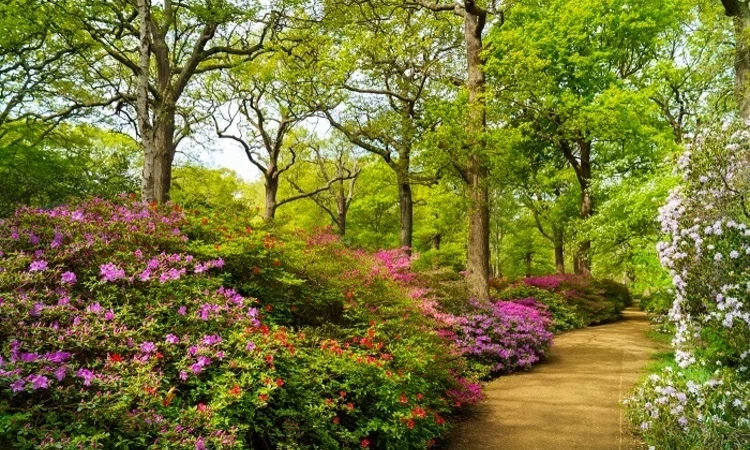
The Isabella Plantation is an ornamental woodland garden, full of exotic plants, that is designed to be interesting all year round.

The Plantation is run on organic principles. Its luscious ground cover and mature trees make good habitat for wildlife and it is part of the Richmond Park Site of Special Scientific Interest. 

Access to the Isabella Plantation

The Isabella Plantation is open year round.

There is a disabled-badge-holders only car park for the Isabella Plantation, access via Ham Cross. Other visitors should use the Broomfield Hill car park.

Plants in the Isabella Plantation

The garden has 15 known varieties of deciduous azalea and houses the national collection of 50 Kurume Azaelas - introduced to the west around 1920 by the plant collector, Ernest Wilson. There are also 50 different species of rhododendron and 120 hybrids.

Isabella Plantation in May

May is the peak flowering season for rhododendrons and azaleas.

Rhododendrons

On the lawn above Thomson's Pond are two beds planted with the Japanese species, Rhododendron yakushimanum, amongst a group of its hybrids named after the Seven Dwarfs: Sneezy, Grumpy etc. These plants are compact and very floriferous.

Also, seek out the tall 'Loderi' hybrid 'King George', with its large soft pink flowers which are sweetly fragrant. It grows in a number places in the Garden but most notably set back above the Still Pond.

Follow the Small Stream down from the Still Pond to discover Rhododendron williamsiananum, a compact species with attractive bronze young shoots, distinctive heart shaped leaves and bell-shaped, shell-pink flowers.

Look out for Rhododendron 'Bibiani'growing in a number of areas in the garden, this shrub produces compact trusses of rich crimson funnel shaped flowers with maroon spots.

Evergreen Azaleas

Easy to identify are:

  • 'Orange Beauty' - the most orange of all
  • 'Amoena' - small bright magenta flowers
  • 'Rosebud' - opening buds resemble tiny roses
  • 'Palestrina' - white with a faint ray of green
  • 'Vuyk's Scarlet' - large flowers of a deep silky red
  • 'Hinode Giri' - bright crimson, around the Still Pond
  • 'Kirin' - a pale pink 'hose in hose' (flower within an flower)

Deciduous Azaleas

These flower slightly later and often have a rich spicy smell, particularly Azalea pontica, Rhododendron luteum, which is yellow and to be found by the gate to Broomfield Hill.

The Bog Garden

Look out for Euphorbia griffithii 'Fireglow', growing in the bed by the middle pond it bares orange-red flowers and has a reddish tinge to the emerging young shoots.

Alongside the margins of pools and streams grows the 'Japanese Primrose', Primula japonica 'Millers Crimson' with its whorls of crimson flowers which are borne in profusion on tall stems, from May to July.

Also present are the young fronds of the 'Shuttlecock Fern', Matteuccia struthiopteris which show an attractive fresh green.

Growing either side of the main pool is the 'Ornamental Rhubarb', Rheum Palmatum, a robust herbaceous perennial with broad, architectural foliage and pink flowers on large erect panicles.

The native tree the 'whitebeam', Sorbus aria, grows near the Broomfield Hill gate and looks particularly attractive at this time of the year with its silvery-white young leaves. Skimmia japonica can also be found growing near this gate along the path that leads onto Camellia Walk and the Still Pond.

The 'Foxglove Tree', Paulownia tomentosa, stands in the glade between the Still Pond and Old Nursery Glade. This large leaved tree bares sprays of fragrant foxglove-like pinkish-lilac flowers in Spring.

The 'Pocket Handkerchief Tree', Davidia involucrata, set back from the Camellia Walk, has intriguing white hanging bracts. Another specimen may be found in a secluded lawn to the southeast of Thomson's Pond.

The 'Snowdrop Tree', Halesia carolina, with dangling white bell flowers, stands by the path above Thomson's Pond.

Cornus nuttallii, whose white bracts appear like flowers, can be found set back in the newly planted Magnolia Glade near the Ham Gate entrance. Also look out for the pale lemon yellow fragrant flowers of Magnolia wilsonii 'Yellow Fever' and the wonderful deep purple flowers of Magnolia liliiflora 'Nigra'.

Bluebells carpet the wilder fringes of the Garden. Please keep to the paths to avoid trampling them.

Types of plants you can find in the Isabella plantation by season

spring

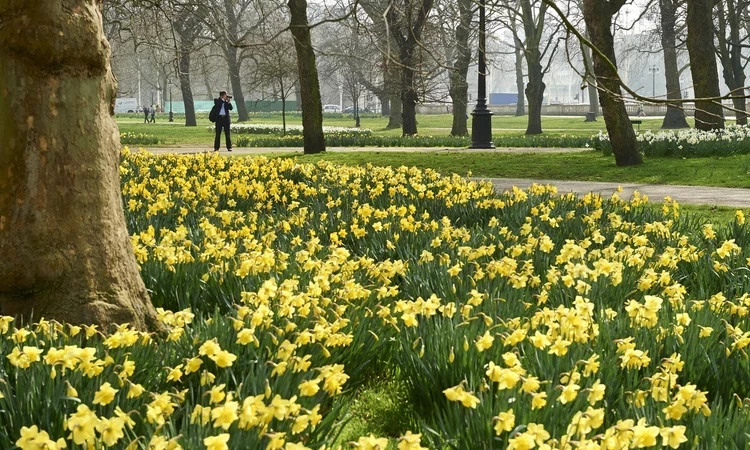
Camellias, magnolias, as well as daffodils and bluebells. From late April, the azaleas and rhododendrons are in flower.

summer

Displays of Japanese irises and day lilies.

Autumn

Guelder rose, rowan and spindle trees are loaded with berries and leaves on the acer trees are turning red.

winter

Even in winter the gardens have scent and colour. There are early camellias and rhododendron, as well as mahonia, winter-flowering heathers and stinking hellebore.

Birds in the Isabella Plantation

The Isabella Plantation is a particularly good place to see birds. Resident species include:

  • redpoll
  • bullfinch
  • wood pecker
  • sparrow hawk
  • tawny owl
  • water fowl such as pintail, tufted duck and pochard.

Visiting birds include:

  • wood warbler, redstart and whitethroat in spring
  • blackcap and spotted flycatcher in summer
  • green sandpiper in autumn
  • siskin and reed bunting in winter.

History of the Isabella Plantation

In the 17th century, this area in the south west corner of Richmond Park was known as The Sleyt. This is the name usually used for boggy ground or an open space between woods or banks.

By 1771, it is shown on maps as Isabella Slade . Isabella may have been the wife or daughter of a member of staff. But it is more likely to be a corruption of the word isabel, which was used as far back as the 15th century to mean dingy or greyish yellow - the colour of the soil in this part of the park.

In 1831, Lord Sidmouth, the park deputy ranger, fenced off 17ha (42 acres) of the Isabella Slade . He planted oak, beech and sweet chestnut trees as a crop for timber and gave the area the name it has today.

The present garden of clearings, ponds and streams was established from the 1950s onwards. It is largely the work of George Thomson, the park superintendent from 1951-1971. Along with his head gardener, Wally Miller, he removed Rhododendron ponticum from large areas and replaced it with other rhododendron species. They established evergreen Kurume Azaleas around the Still Pond and planted other exotic shrub and tree species.

The main stream through the garden from Broomfield Gate was dug in 1960 and the plantation was enlarged to include Peg's Pond.

More recently, in 1989, a wild stream was dug in the northern section and this has now been colonized by ferns, water plantains and brook lime. The Bog Garden was reconstructed in 2000.


Isabella Plantation

Beech Bay in the Isabella Plantation

The Isabella Plantation is an ornamental woodland garden, full of exotic plants, that is designed to be interesting all year round.

The Plantation is run on organic principles. Its luscious ground cover and mature trees make good habitat for wildlife and it is part of the Richmond Park Site of Special Scientific Interest. 

Access to the Isabella Plantation

The Isabella Plantation is open year round.

There is a disabled-badge-holders only car park for the Isabella Plantation, access via Ham Cross. Other visitors should use the Broomfield Hill car park.

Plants in the Isabella Plantation

The garden has 15 known varieties of deciduous azalea and houses the national collection of 50 Kurume Azaelas - introduced to the west around 1920 by the plant collector, Ernest Wilson. There are also 50 different species of rhododendron and 120 hybrids.

Isabella Plantation in May

May is the peak flowering season for rhododendrons and azaleas.

Rhododendrons

On the lawn above Thomson's Pond are two beds planted with the Japanese species, Rhododendron yakushimanum, amongst a group of its hybrids named after the Seven Dwarfs: Sneezy, Grumpy etc. These plants are compact and very floriferous.

Also, seek out the tall 'Loderi' hybrid 'King George', with its large soft pink flowers which are sweetly fragrant. It grows in a number places in the Garden but most notably set back above the Still Pond.

Follow the Small Stream down from the Still Pond to discover Rhododendron williamsiananum, a compact species with attractive bronze young shoots, distinctive heart shaped leaves and bell-shaped, shell-pink flowers.

Look out for Rhododendron 'Bibiani'growing in a number of areas in the garden, this shrub produces compact trusses of rich crimson funnel shaped flowers with maroon spots.

Evergreen Azaleas

Easy to identify are:

  • 'Orange Beauty' - the most orange of all
  • 'Amoena' - small bright magenta flowers
  • 'Rosebud' - opening buds resemble tiny roses
  • 'Palestrina' - white with a faint ray of green
  • 'Vuyk's Scarlet' - large flowers of a deep silky red
  • 'Hinode Giri' - bright crimson, around the Still Pond
  • 'Kirin' - a pale pink 'hose in hose' (flower within an flower)

Deciduous Azaleas

These flower slightly later and often have a rich spicy smell, particularly Azalea pontica, Rhododendron luteum, which is yellow and to be found by the gate to Broomfield Hill.

The Bog Garden

Look out for Euphorbia griffithii 'Fireglow', growing in the bed by the middle pond it bares orange-red flowers and has a reddish tinge to the emerging young shoots.

Alongside the margins of pools and streams grows the 'Japanese Primrose', Primula japonica 'Millers Crimson' with its whorls of crimson flowers which are borne in profusion on tall stems, from May to July.

Also present are the young fronds of the 'Shuttlecock Fern', Matteuccia struthiopteris which show an attractive fresh green.

Growing either side of the main pool is the 'Ornamental Rhubarb', Rheum Palmatum, a robust herbaceous perennial with broad, architectural foliage and pink flowers on large erect panicles.

The native tree the 'whitebeam', Sorbus aria, grows near the Broomfield Hill gate and looks particularly attractive at this time of the year with its silvery-white young leaves. Skimmia japonica can also be found growing near this gate along the path that leads onto Camellia Walk and the Still Pond.

The 'Foxglove Tree', Paulownia tomentosa, stands in the glade between the Still Pond and Old Nursery Glade. This large leaved tree bares sprays of fragrant foxglove-like pinkish-lilac flowers in Spring.

The 'Pocket Handkerchief Tree', Davidia involucrata, set back from the Camellia Walk, has intriguing white hanging bracts. Another specimen may be found in a secluded lawn to the southeast of Thomson's Pond.

The 'Snowdrop Tree', Halesia carolina, with dangling white bell flowers, stands by the path above Thomson's Pond.

Cornus nuttallii, whose white bracts appear like flowers, can be found set back in the newly planted Magnolia Glade near the Ham Gate entrance. Also look out for the pale lemon yellow fragrant flowers of Magnolia wilsonii 'Yellow Fever' and the wonderful deep purple flowers of Magnolia liliiflora 'Nigra'.

Bluebells carpet the wilder fringes of the Garden. Please keep to the paths to avoid trampling them.

Types of plants you can find in the Isabella plantation by season

spring

Camellias, magnolias, as well as daffodils and bluebells. From late April, the azaleas and rhododendrons are in flower.

summer

Displays of Japanese irises and day lilies.

Autumn

Guelder rose, rowan and spindle trees are loaded with berries and leaves on the acer trees are turning red.

winter

Even in winter the gardens have scent and colour. There are early camellias and rhododendron, as well as mahonia, winter-flowering heathers and stinking hellebore.

Birds in the Isabella Plantation

The Isabella Plantation is a particularly good place to see birds. Resident species include:

  • redpoll
  • bullfinch
  • wood pecker
  • sparrow hawk
  • tawny owl
  • water fowl such as pintail, tufted duck and pochard.

Visiting birds include:

  • wood warbler, redstart and whitethroat in spring
  • blackcap and spotted flycatcher in summer
  • green sandpiper in autumn
  • siskin and reed bunting in winter.

History of the Isabella Plantation

In the 17th century, this area in the south west corner of Richmond Park was known as The Sleyt. This is the name usually used for boggy ground or an open space between woods or banks.

By 1771, it is shown on maps as Isabella Slade . Isabella may have been the wife or daughter of a member of staff. But it is more likely to be a corruption of the word isabel, which was used as far back as the 15th century to mean dingy or greyish yellow - the colour of the soil in this part of the park.

In 1831, Lord Sidmouth, the park deputy ranger, fenced off 17ha (42 acres) of the Isabella Slade . He planted oak, beech and sweet chestnut trees as a crop for timber and gave the area the name it has today.

The present garden of clearings, ponds and streams was established from the 1950s onwards. It is largely the work of George Thomson, the park superintendent from 1951-1971. Along with his head gardener, Wally Miller, he removed Rhododendron ponticum from large areas and replaced it with other rhododendron species. They established evergreen Kurume Azaleas around the Still Pond and planted other exotic shrub and tree species.

The main stream through the garden from Broomfield Gate was dug in 1960 and the plantation was enlarged to include Peg's Pond.

More recently, in 1989, a wild stream was dug in the northern section and this has now been colonized by ferns, water plantains and brook lime. The Bog Garden was reconstructed in 2000.

Landing Image
Isabella Plantation

This is some blurb text. This should be changed in the metadata screen for this asset.


Buy Plants Online

Royal Parks Foundation

Trees in the Royal Parks

Blog

Volunteer Gardeners

In Isabella Plantation

Royal Parks Store

Visit the Royal Parks Shop

Lorem Ipsum

Lorem ipsum dolor sit amet pulvinar consectetur elit adisciplin donec avec elit magna pul vinar estbul ipsum elit sit donec ipsum.

Buy now...

Things to see

Things to do

  • Barclaycard presents British Summer Time  Hyde Park

    Barclaycard presents British Summer Time Hyde Park

    Barclaycard presents British Summer Time Hyde Park, a ground breaking new concert series and outdoor experience from 5 July - 14 July 2013.

    More things to do...
  • 7 July Memorial

    7 July Memorial

    A permanent memorial to honour the victims of the 7 July 2005 London Bombings was unveiled in Hyde Park by Their Royal Highnesses, The Prince of Wales and The Duchess of Cornwall.

    More things to do...
  • Diana Memorial Fountain

    Diana Memorial Fountain

    This unique Memorial to Diana, Princess of Wales was opened by Her Majesty The Queen on 6th July 2004 and was built with the best materials, talent and technology.

    More things to do...
  • Royal Gun Salutes

    Royal Gun Salutes

    Royal Gun Salutes mark special royal occasions. On these days salutes are fired from locations in London including Hyde Park and Green Park.

    More things to do...
  • Serpentine Lido

    Serpentine Lido

    Daily public swimming in The Serpentine from June - September. Serpentine Swimming Club swims every day, including the famous race on Christmas day.

    More things to do...
  • Boating in Hyde Park

    Boating in Hyde Park

    Rowing and pedal boats are available to hire on the Serpentine in Hyde Park. You can also take a ride on the UK's first Solarshuttle, powered only by the sun.

    More things to do...
  • The Diana Princess of Wales Memorial Walk

    The Diana Princess of Wales Memorial Walk

    The Diana Princess of Wales Memorial Walk is a seven-mile-long walk, charted by 90 plaques set in the ground, that takes you within sight of famous buildings and locations associated with the Princess during her life.

    More things to do...

Connect with us

Facebook Icon Flickr Icon YouTube Icon Twitter Icon
Beech Bay in the Isabella Plantation

The Isabella Plantation is an ornamental woodland garden, full of exotic plants, that is designed to be interesting all year round.

The Plantation is run on organic principles. Its luscious ground cover and mature trees make good habitat for wildlife and it is part of the Richmond Park Site of Special Scientific Interest. 

Access to the Isabella Plantation

The Isabella Plantation is open year round.

There is a disabled-badge-holders only car park for the Isabella Plantation, access via Ham Cross. Other visitors should use the Broomfield Hill car park.

Plants in the Isabella Plantation

The garden has 15 known varieties of deciduous azalea and houses the national collection of 50 Kurume Azaelas - introduced to the west around 1920 by the plant collector, Ernest Wilson. There are also 50 different species of rhododendron and 120 hybrids.

Isabella Plantation in May

May is the peak flowering season for rhododendrons and azaleas.

Rhododendrons

On the lawn above Thomson's Pond are two beds planted with the Japanese species, Rhododendron yakushimanum, amongst a group of its hybrids named after the Seven Dwarfs: Sneezy, Grumpy etc. These plants are compact and very floriferous.

Also, seek out the tall 'Loderi' hybrid 'King George', with its large soft pink flowers which are sweetly fragrant. It grows in a number places in the Garden but most notably set back above the Still Pond.

Follow the Small Stream down from the Still Pond to discover Rhododendron williamsiananum, a compact species with attractive bronze young shoots, distinctive heart shaped leaves and bell-shaped, shell-pink flowers.

Look out for Rhododendron 'Bibiani'growing in a number of areas in the garden, this shrub produces compact trusses of rich crimson funnel shaped flowers with maroon spots.

Evergreen Azaleas

Easy to identify are:

Deciduous Azaleas

These flower slightly later and often have a rich spicy smell, particularly Azalea pontica, Rhododendron luteum, which is yellow and to be found by the gate to Broomfield Hill.

The Bog Garden

Look out for Euphorbia griffithii 'Fireglow', growing in the bed by the middle pond it bares orange-red flowers and has a reddish tinge to the emerging young shoots.

Alongside the margins of pools and streams grows the 'Japanese Primrose', Primula japonica 'Millers Crimson' with its whorls of crimson flowers which are borne in profusion on tall stems, from May to July.

Also present are the young fronds of the 'Shuttlecock Fern', Matteuccia struthiopteris which show an attractive fresh green.

Growing either side of the main pool is the 'Ornamental Rhubarb', Rheum Palmatum, a robust herbaceous perennial with broad, architectural foliage and pink flowers on large erect panicles.

The native tree the 'whitebeam', Sorbus aria, grows near the Broomfield Hill gate and looks particularly attractive at this time of the year with its silvery-white young leaves. Skimmia japonica can also be found growing near this gate along the path that leads onto Camellia Walk and the Still Pond.

The 'Foxglove Tree', Paulownia tomentosa, stands in the glade between the Still Pond and Old Nursery Glade. This large leaved tree bares sprays of fragrant foxglove-like pinkish-lilac flowers in Spring.

The 'Pocket Handkerchief Tree', Davidia involucrata, set back from the Camellia Walk, has intriguing white hanging bracts. Another specimen may be found in a secluded lawn to the southeast of Thomson's Pond.

The 'Snowdrop Tree', Halesia carolina, with dangling white bell flowers, stands by the path above Thomson's Pond.

Cornus nuttallii, whose white bracts appear like flowers, can be found set back in the newly planted Magnolia Glade near the Ham Gate entrance. Also look out for the pale lemon yellow fragrant flowers of Magnolia wilsonii 'Yellow Fever' and the wonderful deep purple flowers of Magnolia liliiflora 'Nigra'.

Bluebells carpet the wilder fringes of the Garden. Please keep to the paths to avoid trampling them.

Types of plants you can find in the Isabella plantation by season

spring

Camellias, magnolias, as well as daffodils and bluebells. From late April, the azaleas and rhododendrons are in flower.

summer

Displays of Japanese irises and day lilies.

Autumn

Guelder rose, rowan and spindle trees are loaded with berries and leaves on the acer trees are turning red.

winter

Even in winter the gardens have scent and colour. There are early camellias and rhododendron, as well as mahonia, winter-flowering heathers and stinking hellebore.

Birds in the Isabella Plantation

The Isabella Plantation is a particularly good place to see birds. Resident species include:

Visiting birds include:

History of the Isabella Plantation

In the 17th century, this area in the south west corner of Richmond Park was known as The Sleyt. This is the name usually used for boggy ground or an open space between woods or banks.

By 1771, it is shown on maps as Isabella Slade . Isabella may have been the wife or daughter of a member of staff. But it is more likely to be a corruption of the word isabel, which was used as far back as the 15th century to mean dingy or greyish yellow - the colour of the soil in this part of the park.

In 1831, Lord Sidmouth, the park deputy ranger, fenced off 17ha (42 acres) of the Isabella Slade . He planted oak, beech and sweet chestnut trees as a crop for timber and gave the area the name it has today.

The present garden of clearings, ponds and streams was established from the 1950s onwards. It is largely the work of George Thomson, the park superintendent from 1951-1971. Along with his head gardener, Wally Miller, he removed Rhododendron ponticum from large areas and replaced it with other rhododendron species. They established evergreen Kurume Azaleas around the Still Pond and planted other exotic shrub and tree species.

The main stream through the garden from Broomfield Gate was dug in 1960 and the plantation was enlarged to include Peg's Pond.

More recently, in 1989, a wild stream was dug in the northern section and this has now been colonized by ferns, water plantains and brook lime. The Bog Garden was reconstructed in 2000.