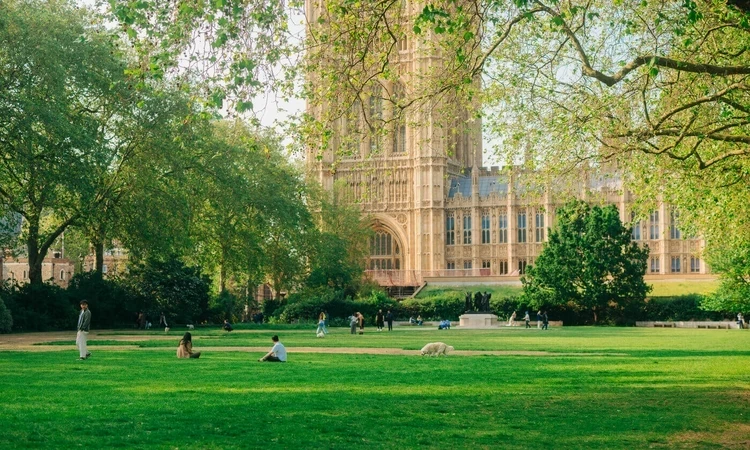
St James's Park is the oldest Royal Park in London and is surrounded by three palaces. The most ancient is Westminster, which has now become the Houses of Parliament, St James's Palace and of course, the best known, Buckingham Palace.
The park was once a marshy watermeadow. In the thirteenth century a leper hospital was founded, and it is from this hospital that the park took its name. In 1532 Henry VIII acquired the site as yet another deer park and built the Palace of St James's. When Elizabeth I came to the throne she indulged her love of pageantry and pomp, and fetes of all kinds were held in the park. Her successor, James I, improved the drainage and controlled the water supply. A road was created in front of St James's Palace, approximately where the Mall is today, but it was Charles II who made dramatic changes. The park was redesigned, with avenues of trees planted and lawns laid. The King opened the park to the public and was a frequent visitor, feeding the ducks and mingling with his subjects.
During the Hanoverian period, Horse Guards Parade was created by filling in one end of the long canal and was used first as a mustering ground and later for parades. Horse Guards Parade is still part of St James's Park. The park changed forever when John Nash redesigned it in a more romantic style. The canal was transformed into a natural-looking lake and in 1837 the Ornithological Society of London presented some birds to the park and erected a cottage for a birdkeeper. Both the cottage and the position of birdkeeper remain to this day. Clarence House was designed for the Duke of Clarence, later to become William IV and was also the home of the late Queen Elizabeth, The Queen Mother.
Outside Buckingham Palace is the Queen Victoria Memorial, which celebrates the days of the British Empire. The memorial includes not only the marble statue of Victoria and the glittering figures of Victory, Courage and Constancy, but also the ornamental gates given by the Dominions. These are the Australia Gate, South Africa Gate and Canada Gate.
St James's Park is the oldest Royal Park in London and is surrounded by three palaces. The most ancient is Westminster, which has now become the Houses of Parliament, St James's Palace and of course, the best known, Buckingham Palace.
The park was once a marshy watermeadow. In the thirteenth century a leper hospital was founded, and it is from this hospital that the park took its name. In 1532 Henry VIII acquired the site as yet another deer park and built the Palace of St James's. When Elizabeth I came to the throne she indulged her love of pageantry and pomp, and fetes of all kinds were held in the park. Her successor, James I, improved the drainage and controlled the water supply. A road was created in front of St James's Palace, approximately where the Mall is today, but it was Charles II who made dramatic changes. The park was redesigned, with avenues of trees planted and lawns laid. The King opened the park to the public and was a frequent visitor, feeding the ducks and mingling with his subjects.
During the Hanoverian period, Horse Guards Parade was created by filling in one end of the long canal and was used first as a mustering ground and later for parades. Horse Guards Parade is still part of St James's Park. The park changed forever when John Nash redesigned it in a more romantic style. The canal was transformed into a natural-looking lake and in 1837 the Ornithological Society of London presented some birds to the park and erected a cottage for a birdkeeper. Both the cottage and the position of birdkeeper remain to this day. Clarence House was designed for the Duke of Clarence, later to become William IV and was also the home of the late Queen Elizabeth, The Queen Mother.
Outside Buckingham Palace is the Queen Victoria Memorial, which celebrates the days of the British Empire. The memorial includes not only the marble statue of Victoria and the glittering figures of Victory, Courage and Constancy, but also the ornamental gates given by the Dominions. These are the Australia Gate, South Africa Gate and Canada Gate.
This is some blurb text. This should be changed in the metadata screen for this asset.
Lorem ipsum dolor sit amet pulvinar consectetur elit adisciplin donec avec elit magna pul vinar estbul ipsum elit sit donec ipsum.
Buy now...
Barclaycard presents British Summer Time Hyde Park, a ground breaking new concert series and outdoor experience from 5 July - 14 July 2013.
More things to do...
A permanent memorial to honour the victims of the 7 July 2005 London Bombings was unveiled in Hyde Park by Their Royal Highnesses, The Prince of Wales and The Duchess of Cornwall.
More things to do...
This unique Memorial to Diana, Princess of Wales was opened by Her Majesty The Queen on 6th July 2004 and was built with the best materials, talent and technology.
More things to do...
Royal Gun Salutes mark special royal occasions. On these days salutes are fired from locations in London including Hyde Park and Green Park.
More things to do...
Daily public swimming in The Serpentine from June - September. Serpentine Swimming Club swims every day, including the famous race on Christmas day.
More things to do...
Rowing and pedal boats are available to hire on the Serpentine in Hyde Park. You can also take a ride on the UK's first Solarshuttle, powered only by the sun.
More things to do...
The Diana Princess of Wales Memorial Walk is a seven-mile-long walk, charted by 90 plaques set in the ground, that takes you within sight of famous buildings and locations associated with the Princess during her life.
More things to do...St James's Park is the oldest Royal Park in London and is surrounded by three palaces. The most ancient is Westminster, which has now become the Houses of Parliament, St James's Palace and of course, the best known, Buckingham Palace.
The park was once a marshy watermeadow. In the thirteenth century a leper hospital was founded, and it is from this hospital that the park took its name. In 1532 Henry VIII acquired the site as yet another deer park and built the Palace of St James's. When Elizabeth I came to the throne she indulged her love of pageantry and pomp, and fetes of all kinds were held in the park. Her successor, James I, improved the drainage and controlled the water supply. A road was created in front of St James's Palace, approximately where the Mall is today, but it was Charles II who made dramatic changes. The park was redesigned, with avenues of trees planted and lawns laid. The King opened the park to the public and was a frequent visitor, feeding the ducks and mingling with his subjects.
During the Hanoverian period, Horse Guards Parade was created by filling in one end of the long canal and was used first as a mustering ground and later for parades. Horse Guards Parade is still part of St James's Park. The park changed forever when John Nash redesigned it in a more romantic style. The canal was transformed into a natural-looking lake and in 1837 the Ornithological Society of London presented some birds to the park and erected a cottage for a birdkeeper. Both the cottage and the position of birdkeeper remain to this day. Clarence House was designed for the Duke of Clarence, later to become William IV and was also the home of the late Queen Elizabeth, The Queen Mother.
Outside Buckingham Palace is the Queen Victoria Memorial, which celebrates the days of the British Empire. The memorial includes not only the marble statue of Victoria and the glittering figures of Victory, Courage and Constancy, but also the ornamental gates given by the Dominions. These are the Australia Gate, South Africa Gate and Canada Gate.