| Name of monument | Boys with armorial shields on pillars | |
| Description | Six stone piers topped by boys, each holding shields bearing the Bute coat of arms. | |
| Location | St John’s Lodge Garden, in front of St John’s Lodge. | |
| History\background | Installed probably for the Marquess of Bute who leased St John’s Lodge in 1888 | |
| Designer | Three by Sir William Goscombe John in 1894; one by Harold Youngman in 1938 and two undated. | |
| Dates | See above. | |
| Maintenance\care | The Royal Parks | |
| Interesting facts | Grade II listed structure. |
| Name of monument | Boy and frog statue | |
| Description | Bronze figure of a boy and a frog on a pedestal of Finnish granite, set in a pond. | |
| Location | Alongside the Tritton Fountain in Queen Mary’s Garden. | |
| History\background | Donated by Sigismund Goetze, a local artist and supporter of The Regent’s Park. | |
| Designer | Sir William Reid Dick. | |
| Dates | 1936 | |
| Maintenance\care | The Royal Parks | |
| Interesting facts | Grade II listed. Sir William Reid Dick was a contemporary of William McMillan, designer of the Tritton Fountain. |
| Name of monument | Fossil trees | |
| Description | Specimens of fossilised wood. | |
| Location | Near the waterfall in Queen Mary’s Gardens. | |
| History\background | Placed in the garden by the Royal Botanical Society | |
| Designer | ||
| Dates | About 1845 | |
| Maintenance\care | The Royal Parks | |
| Interesting facts | Excavated from the Lower Purbeck beds in Dorset formed 150 million years ago |
| Name of monument | The Goatherd’s Daughter statue | |
| Description | Grade II listed bronze of a woman carried a young goat. | |
| Location | St John’s Lodge Garden, north east of Inner Circle. | |
| History\background | Erected in honour of Harold and Gertrude Baillie Weaver by the National Council for Animal Welfare. Moved in 1994 within the extended garden at St John’s Lodge. | |
| Designer | Charles Leonard Hartwell. | |
| Dates | 1932 | |
| Maintenance\care | The Royal Parks | |
| Interesting facts | The inscription reads: “To all the Protectors of the Defenceless”. The designer received the Royal British Society of Sculptors Silver Medal for this statue. |
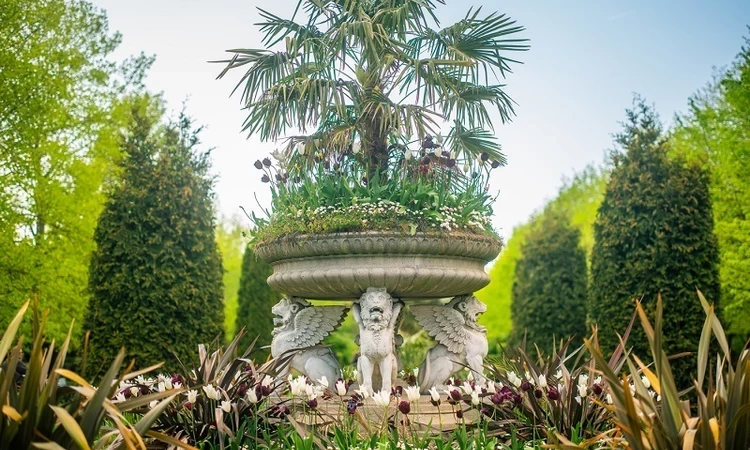
| Name of monument | Griffin or Lion Tazza. Sometimes called the Lion Vase | |
| Description | Large circular stone bowl supported by four winged stone lions. | |
| Location | To the left of the main path, in the centre of the Avenue Gardens. | |
| History\background | Installed in the Italian-style Avenue Gardens by William Andrews Nesfield. | |
| Designer | Austin and Seeley. | |
| Dates | 1863 | |
| Maintenance\care | The Royal Parks | |
| Interesting facts | One of about 30 stone vases in the Avenue Gardens. The Tazza was repaired during the restoration of the gardens in 1993-1996. |
| Name of monument | Hylas and the Nymph statue | |
| Description | Grade II listed bronze statue of a boy and a mermaid on a stone pedestal, set in a stone-rimmed pond. | |
| Location | St John’s Lodge Garden, north east of Inner Circle. | |
| History\background | Donated by the Royal Academy of Arts. | |
| Designer | Henry Pegram. | |
| Dates | 1933 | |
| Maintenance\care | The Royal Parks | |
| Interesting facts | In Greek mythology, Hylas was one of the Argonauts, the heroes who accompanied Jason on the quest for the Golden Fleece. During the journey, Hylas was kidnapped by the nymph of spring and never seen again. |
| Name of monument | Jubilee Gates | |
| Description | Grade II listed grand iron and gilded semi-circular gates. | |
| Location | Main entrance to Queen Mary’s Gardens near York Bridge, off Inner Circle. | |
| History\background | Installed to mark the Silver Jubilee of King George V and the official opening of Queen Mary’s Gardens in 1935. | |
| Designer | ||
| Dates | 1935 | |
| Maintenance\care | The Royal Parks | |
| Interesting facts | Donated by Sigismund Goetze, a successful local artist. |
| Name of monument | Ready Money drinking fountain | |
| Description | Four-sided granite and marble gothic drinking fountain. | |
| Location | North end of the Broad Walk. | |
| History\background | Given to the park in 1869 by Sir Cowasjee Jehangir, a wealthy Parsee industrialist from Bombay, whose nickname was Ready Money. It was his thank-you for the protection he and fellow Parsees received from British rule in India. | |
| Designer | ||
| Dates | 1869 | |
| Maintenance\care | The Royal Parks | |
| Interesting facts | One of the largest drinking fountains in London. Contains 10 tonnes of Sicilian marble and four tonnes of red Aberdeen granite. It was unveiled by Princess Mary of Teck, later Queen Mary after whom Queen Mary’s Gardens are named. |
| Name of monument | Shakespeare’s Tree | |
| Description | Oak tree. | |
| Location | The slope of Primrose Hill. | |
| History\background | A replacement tree for a young oak planted in 1864 to mark the 300th anniversary of Shakespeare’s birth. | |
| Designer | ||
| Dates | Present tree planted 1964. | |
| Maintenance\care | The Royal Parks | |
| Interesting facts | A large crowd of workmen marched through London to watch the planting ceremony in 1864. |
| Name of monument | Triton fountain | |
| Description | Queen Mary’s Garden, opposite the Jubilee Gates. | |
| Location | Bronze sculptures of a sea god or triton blowing on a conch shell with two mermaids at his feet. The group stand in the centre of a round pool. | |
| History\background | Sigismund Goetze donated the pond and after he died, his wife Constance donated the fountain in his memory. | |
| Designer | William McMillan. | |
| Dates | 1950 | |
| Maintenance\care | The Royal Parks | |
| Interesting facts | The fountain is on the site of a huge conservatory measuring over 1,700 sq m. The conservatory belonged to the Royal Botanical Society, which gave up the site in 1931. William McMillan designed one of the fountains in Trafalgar Square. |
| Name of monument | Boys with armorial shields on pillars | |
| Description | Six stone piers topped by boys, each holding shields bearing the Bute coat of arms. | |
| Location | St John’s Lodge Garden, in front of St John’s Lodge. | |
| History\background | Installed probably for the Marquess of Bute who leased St John’s Lodge in 1888 | |
| Designer | Three by Sir William Goscombe John in 1894; one by Harold Youngman in 1938 and two undated. | |
| Dates | See above. | |
| Maintenance\care | The Royal Parks | |
| Interesting facts | Grade II listed structure. |
| Name of monument | Boy and frog statue | |
| Description | Bronze figure of a boy and a frog on a pedestal of Finnish granite, set in a pond. | |
| Location | Alongside the Tritton Fountain in Queen Mary’s Garden. | |
| History\background | Donated by Sigismund Goetze, a local artist and supporter of The Regent’s Park. | |
| Designer | Sir William Reid Dick. | |
| Dates | 1936 | |
| Maintenance\care | The Royal Parks | |
| Interesting facts | Grade II listed. Sir William Reid Dick was a contemporary of William McMillan, designer of the Tritton Fountain. |
| Name of monument | Fossil trees | |
| Description | Specimens of fossilised wood. | |
| Location | Near the waterfall in Queen Mary’s Gardens. | |
| History\background | Placed in the garden by the Royal Botanical Society | |
| Designer | ||
| Dates | About 1845 | |
| Maintenance\care | The Royal Parks | |
| Interesting facts | Excavated from the Lower Purbeck beds in Dorset formed 150 million years ago |
| Name of monument | The Goatherd’s Daughter statue | |
| Description | Grade II listed bronze of a woman carried a young goat. | |
| Location | St John’s Lodge Garden, north east of Inner Circle. | |
| History\background | Erected in honour of Harold and Gertrude Baillie Weaver by the National Council for Animal Welfare. Moved in 1994 within the extended garden at St John’s Lodge. | |
| Designer | Charles Leonard Hartwell. | |
| Dates | 1932 | |
| Maintenance\care | The Royal Parks | |
| Interesting facts | The inscription reads: “To all the Protectors of the Defenceless”. The designer received the Royal British Society of Sculptors Silver Medal for this statue. |
| Name of monument | Griffin or Lion Tazza. Sometimes called the Lion Vase | |
| Description | Large circular stone bowl supported by four winged stone lions. | |
| Location | To the left of the main path, in the centre of the Avenue Gardens. | |
| History\background | Installed in the Italian-style Avenue Gardens by William Andrews Nesfield. | |
| Designer | Austin and Seeley. | |
| Dates | 1863 | |
| Maintenance\care | The Royal Parks | |
| Interesting facts | One of about 30 stone vases in the Avenue Gardens. The Tazza was repaired during the restoration of the gardens in 1993-1996. |
| Name of monument | Hylas and the Nymph statue | |
| Description | Grade II listed bronze statue of a boy and a mermaid on a stone pedestal, set in a stone-rimmed pond. | |
| Location | St John’s Lodge Garden, north east of Inner Circle. | |
| History\background | Donated by the Royal Academy of Arts. | |
| Designer | Henry Pegram. | |
| Dates | 1933 | |
| Maintenance\care | The Royal Parks | |
| Interesting facts | In Greek mythology, Hylas was one of the Argonauts, the heroes who accompanied Jason on the quest for the Golden Fleece. During the journey, Hylas was kidnapped by the nymph of spring and never seen again. |
| Name of monument | Jubilee Gates | |
| Description | Grade II listed grand iron and gilded semi-circular gates. | |
| Location | Main entrance to Queen Mary’s Gardens near York Bridge, off Inner Circle. | |
| History\background | Installed to mark the Silver Jubilee of King George V and the official opening of Queen Mary’s Gardens in 1935. | |
| Designer | ||
| Dates | 1935 | |
| Maintenance\care | The Royal Parks | |
| Interesting facts | Donated by Sigismund Goetze, a successful local artist. |
| Name of monument | Ready Money drinking fountain | |
| Description | Four-sided granite and marble gothic drinking fountain. | |
| Location | North end of the Broad Walk. | |
| History\background | Given to the park in 1869 by Sir Cowasjee Jehangir, a wealthy Parsee industrialist from Bombay, whose nickname was Ready Money. It was his thank-you for the protection he and fellow Parsees received from British rule in India. | |
| Designer | ||
| Dates | 1869 | |
| Maintenance\care | The Royal Parks | |
| Interesting facts | One of the largest drinking fountains in London. Contains 10 tonnes of Sicilian marble and four tonnes of red Aberdeen granite. It was unveiled by Princess Mary of Teck, later Queen Mary after whom Queen Mary’s Gardens are named. |
| Name of monument | Shakespeare’s Tree | |
| Description | Oak tree. | |
| Location | The slope of Primrose Hill. | |
| History\background | A replacement tree for a young oak planted in 1864 to mark the 300th anniversary of Shakespeare’s birth. | |
| Designer | ||
| Dates | Present tree planted 1964. | |
| Maintenance\care | The Royal Parks | |
| Interesting facts | A large crowd of workmen marched through London to watch the planting ceremony in 1864. |
| Name of monument | Triton fountain | |
| Description | Queen Mary’s Garden, opposite the Jubilee Gates. | |
| Location | Bronze sculptures of a sea god or triton blowing on a conch shell with two mermaids at his feet. The group stand in the centre of a round pool. | |
| History\background | Sigismund Goetze donated the pond and after he died, his wife Constance donated the fountain in his memory. | |
| Designer | William McMillan. | |
| Dates | 1950 | |
| Maintenance\care | The Royal Parks | |
| Interesting facts | The fountain is on the site of a huge conservatory measuring over 1,700 sq m. The conservatory belonged to the Royal Botanical Society, which gave up the site in 1931. William McMillan designed one of the fountains in Trafalgar Square. |
This is some blurb text. This should be changed in the metadata screen for this asset.
Lorem ipsum dolor sit amet pulvinar consectetur elit adisciplin donec avec elit magna pul vinar estbul ipsum elit sit donec ipsum.
Buy now...
Enter a brief description of the page. This should be a summary of the contents and theme of the page.
More things to see...
Enter a brief description of the page. This should be a summary of the contents and theme of the page.
More things to see...
Enter a brief description of the page. This should be a summary of the contents and theme of the page.
More things to see...
Enter a brief description of the page. This should be a summary of the contents and theme of the page.
More things to see...
Enter a brief description of the page. This should be a summary of the contents and theme of the page.
More things to do...
Enter a brief description of the page. This should be a summary of the contents and theme of the page.
More things to do...
Enter a brief description of the page. This should be a summary of the contents and theme of the page.
More things to do...
Enter a brief description of the page. This should be a summary of the contents and theme of the page.
More things to do...| Name of monument | Boys with armorial shields on pillars | |
| Description | Six stone piers topped by boys, each holding shields bearing the Bute coat of arms. | |
| Location | St John’s Lodge Garden, in front of St John’s Lodge. | |
| History\background | Installed probably for the Marquess of Bute who leased St John’s Lodge in 1888 | |
| Designer | Three by Sir William Goscombe John in 1894; one by Harold Youngman in 1938 and two undated. | |
| Dates | See above. | |
| Maintenance\care | The Royal Parks | |
| Interesting facts | Grade II listed structure. |
| Name of monument | Boy and frog statue | |
| Description | Bronze figure of a boy and a frog on a pedestal of Finnish granite, set in a pond. | |
| Location | Alongside the Tritton Fountain in Queen Mary’s Garden. | |
| History\background | Donated by Sigismund Goetze, a local artist and supporter of The Regent’s Park. | |
| Designer | Sir William Reid Dick. | |
| Dates | 1936 | |
| Maintenance\care | The Royal Parks | |
| Interesting facts | Grade II listed. Sir William Reid Dick was a contemporary of William McMillan, designer of the Tritton Fountain. |
| Name of monument | Fossil trees | |
| Description | Specimens of fossilised wood. | |
| Location | Near the waterfall in Queen Mary’s Gardens. | |
| History\background | Placed in the garden by the Royal Botanical Society | |
| Designer | ||
| Dates | About 1845 | |
| Maintenance\care | The Royal Parks | |
| Interesting facts | Excavated from the Lower Purbeck beds in Dorset formed 150 million years ago |
| Name of monument | The Goatherd’s Daughter statue | |
| Description | Grade II listed bronze of a woman carried a young goat. | |
| Location | St John’s Lodge Garden, north east of Inner Circle. | |
| History\background | Erected in honour of Harold and Gertrude Baillie Weaver by the National Council for Animal Welfare. Moved in 1994 within the extended garden at St John’s Lodge. | |
| Designer | Charles Leonard Hartwell. | |
| Dates | 1932 | |
| Maintenance\care | The Royal Parks | |
| Interesting facts | The inscription reads: “To all the Protectors of the Defenceless”. The designer received the Royal British Society of Sculptors Silver Medal for this statue. |
| Name of monument | Griffin or Lion Tazza. Sometimes called the Lion Vase | |
| Description | Large circular stone bowl supported by four winged stone lions. | |
| Location | To the left of the main path, in the centre of the Avenue Gardens. | |
| History\background | Installed in the Italian-style Avenue Gardens by William Andrews Nesfield. | |
| Designer | Austin and Seeley. | |
| Dates | 1863 | |
| Maintenance\care | The Royal Parks | |
| Interesting facts | One of about 30 stone vases in the Avenue Gardens. The Tazza was repaired during the restoration of the gardens in 1993-1996. |
| Name of monument | Hylas and the Nymph statue | |
| Description | Grade II listed bronze statue of a boy and a mermaid on a stone pedestal, set in a stone-rimmed pond. | |
| Location | St John’s Lodge Garden, north east of Inner Circle. | |
| History\background | Donated by the Royal Academy of Arts. | |
| Designer | Henry Pegram. | |
| Dates | 1933 | |
| Maintenance\care | The Royal Parks | |
| Interesting facts | In Greek mythology, Hylas was one of the Argonauts, the heroes who accompanied Jason on the quest for the Golden Fleece. During the journey, Hylas was kidnapped by the nymph of spring and never seen again. |
| Name of monument | Jubilee Gates | |
| Description | Grade II listed grand iron and gilded semi-circular gates. | |
| Location | Main entrance to Queen Mary’s Gardens near York Bridge, off Inner Circle. | |
| History\background | Installed to mark the Silver Jubilee of King George V and the official opening of Queen Mary’s Gardens in 1935. | |
| Designer | ||
| Dates | 1935 | |
| Maintenance\care | The Royal Parks | |
| Interesting facts | Donated by Sigismund Goetze, a successful local artist. |
| Name of monument | Ready Money drinking fountain | |
| Description | Four-sided granite and marble gothic drinking fountain. | |
| Location | North end of the Broad Walk. | |
| History\background | Given to the park in 1869 by Sir Cowasjee Jehangir, a wealthy Parsee industrialist from Bombay, whose nickname was Ready Money. It was his thank-you for the protection he and fellow Parsees received from British rule in India. | |
| Designer | ||
| Dates | 1869 | |
| Maintenance\care | The Royal Parks | |
| Interesting facts | One of the largest drinking fountains in London. Contains 10 tonnes of Sicilian marble and four tonnes of red Aberdeen granite. It was unveiled by Princess Mary of Teck, later Queen Mary after whom Queen Mary’s Gardens are named. |
| Name of monument | Shakespeare’s Tree | |
| Description | Oak tree. | |
| Location | The slope of Primrose Hill. | |
| History\background | A replacement tree for a young oak planted in 1864 to mark the 300th anniversary of Shakespeare’s birth. | |
| Designer | ||
| Dates | Present tree planted 1964. | |
| Maintenance\care | The Royal Parks | |
| Interesting facts | A large crowd of workmen marched through London to watch the planting ceremony in 1864. |
| Name of monument | Triton fountain | |
| Description | Queen Mary’s Garden, opposite the Jubilee Gates. | |
| Location | Bronze sculptures of a sea god or triton blowing on a conch shell with two mermaids at his feet. The group stand in the centre of a round pool. | |
| History\background | Sigismund Goetze donated the pond and after he died, his wife Constance donated the fountain in his memory. | |
| Designer | William McMillan. | |
| Dates | 1950 | |
| Maintenance\care | The Royal Parks | |
| Interesting facts | The fountain is on the site of a huge conservatory measuring over 1,700 sq m. The conservatory belonged to the Royal Botanical Society, which gave up the site in 1931. William McMillan designed one of the fountains in Trafalgar Square. |