
Zombie Spiders and the Hidden Wildlife of Brompton Cemetery
Deep beneath Brompton Cemetery, something rather spooky is happening. In the darkness of its historic catacombs, scientists have discovered spiders infected by a mysterious fungus.
These so-called ‘zombie spiders’ are just one of the extraordinary wildlife discoveries at Brompton Cemetery, where hundreds of species are thriving among the gravestones, acid grasslands and ancient trees.
Meet Brompton Cemetery’s ‘zombie’ spiders
During recent investigations in the cemetery’s catacombs, a mycologist from the Royal Botanic Gardens, Kew identified a fungus called Lecanicillium tenuipes growing on cellar spiders (Pholcus phalangioides).

This fungus is a specialised parasite of this spider species, eventually killing its host. It grows inside the spider’s body before emerging through the joints in its exoskeleton, creating the ghostly, motionless specimens discovered hanging on the ceiling of the catacombs.

But there’s more to this discovery than just its eerie appearance. Some spider-infecting fungi can also alter their hosts’ behaviour, causing infected spiders to climb into more exposed positions before they die.

This unusual behaviour can help the fungus spread. By positioning its host somewhere higher and more open, the fungus gives its spores a better chance of dispersing through the air and reaching other spiders.
It’s a fascinating example of how a parasite can influence the behaviour of another animal to help ensure its own survival. Although spider-infecting fungi aren't unique to Brompton Cemetery, they remain relatively under-studied, making discoveries like these valuable to scientific research.
A remarkable diversity of invertebrates
However, the catacombs are just one part of Brompton Cemetery’s complex ecosystem. Above ground, its grasslands, meadows, trees and deadwood provide a variety of habitats for different invertebrates.
A recent baseline survey commissioned by The Royal Parks, covering 2024 and 2025, recorded 468 invertebrate species at Brompton Cemetery, including 27 species of conservation interest.
The records included spiders, beetles, bees, ants, wasps, flies, butterflies and moths. Together, these findings reveal just how important this historic green space is for wildlife in a heavily urbanised part of London.

The survey also identified some of the habitats and resources that are especially valuable to these invertebrates. Open grassland, including shorter grass and daisy-rich areas, anthills, and patches of bare ground around paths and graves were among the important features recorded.
These small, sometimes overlooked features provide opportunities for invertebrates to feed, shelter and complete their life cycles. They show how even the smallest spaces within a historic cemetery can support a remarkable diversity of life.
Why a little wildness matters
Supporting this diversity means making space for nature, even in a historic landscape that people may be used to seeing carefully maintained.
If you've ever noticed areas of longer grass at Brompton Cemetery, there's a good reason. By cutting different areas at different times, our teams create a mixture of habitats, giving insects places to feed, shelter and reproduce.
Some areas are kept shorter, while others are allowed to grow for longer, encouraging flowering plants and providing cover for wildlife. This varied approach helps support different species, each with their own needs.
Trees and deadwood are also valuable. Older trees provide shelter and support wildlife that feeds on foliage, while decaying wood creates habitats for invertebrates and fungi. Protecting mature ivy and increasing the availability of deadwood can provide further resources for these often-overlooked species.

Together, these habitats create the conditions for a rich community of wildlife to thrive. Through careful management and conservation work - supported by Players of Postcode Lottery - The Royal Parks helps maintain this variety of life alongside Brompton Cemetery’s historic monuments and its many visitors.
So, the next time you see a patch of longer grass or a fallen branch left in place, it might be worth taking a closer look. What appears overgrown at first glance could be an important part of a thriving habitat.
Brompton Cemetery is a place of remembrance, history and reflection, but it is also a living landscape full of unexpected discoveries. From fungi growing on spiders, to beetles eating deadwood to anthills among the grass, its hidden wildlife shows just how much can be happening in the places we might otherwise overlook.
Discover more at Brompton Cemetery this half term
Curious about the hidden wildlife living at Brompton Cemetery? This October half term, discover more about the fascinating natural world on your doorstep at our free Nature Roadshow on Thursday 29 October, from 11am to 3pm.
With drop-in activities for the whole family, it's a chance to explore, learn and see this remarkable green space in a new light.

Related Articles
-
 Read
Top things to do in the Royal Parks this autumn
Discover the best things to do in London's Royal Parks this autumn including Halloween events, creative workshops and stunning seasonal walks.
-
 Read
Ghosts of the Royal Parks
Tales from the archives of a few of the ghosts people have reported seeing in London's Royal Parks.
-
 Listen
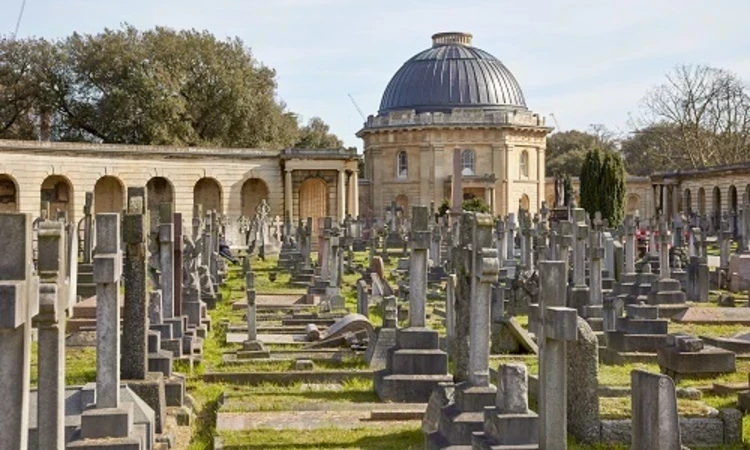
Brompton Cemetery - Halloween Special
In this Halloween special we are talking with Brompton Cemetery's Business Development & Cemetery Services Manager.


